N.H. Rental Market Tightens
Apartments are harder to find and more expensive to rent in New Hampshire this year.
Vacancy rates have dipped to 3.2 percent statewide for two-bedroom apartments, the largest category of rental units in the state, reports the New Hampshire Housing Finance Authority.
A rate in the low 3 percent range indicates that available units are becoming more difficult to find, according to state housing officials, who note that a balanced market would have vacancy rates between 4 percent and 5 percent.
The state’s vacancy rate for two-bedroom apartments has been declining since 2009 when it was 4.7 percent.
The increased demand and limited availability of two-bedroom apartments has led to an increase in rents. The median monthly gross rent has risen just over 3 percent during the past year to $1,085 per month, including utilities, statewide, according to the housing finance agency, which keeps a close eye on multifamily housing conditions. New Hampshire Housing administers the low-income housing tax credit and a number of other programs to help developers build affordable housing and assist low- and moderate-income families obtain housing.
“The survey results are not surprising,” says Executive Director Dean Christon. “Given the foreclosure activity over the past few years, greater numbers of former homeowners have entered the rental market, and this has naturally caused rental rates to rise.”
The study is conducted each April by the University of New Hampshire Survey Center and New Hampshire Housing. The 2012 survey compares information on 32,494 market-rate rental units across the state.
“The Residential Rental Cost Survey” provides a comprehensive picture of the status of rental housing in New Hampshire. The report is available at www.nhhfa.org.
Wolfeboro, N.H., is known as the “oldest summer resort in America.”
Visitors go there to boat and swim in the lakes in the summer and then to snowmobile and ski along the trails during the winter. Republican presidential nominee Mitt Romney and his family recently gathered there for their annual vacation.
It’s a desirable place to live and retire, but affordable housing options have been few in the affluent town of roughly 6,000 residents.
As a result, many of the people who work in the vital tourist and service industries cannot afford to live in Wolfeboro.
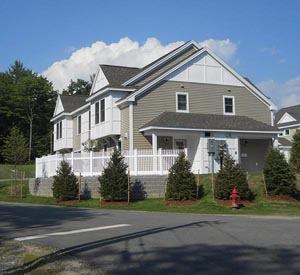
Harriman Hill helps change that. The new low-income housing tax credit (LIHTC) development provides 24 units of affordable housing for residents earning no more than 50 percent and 60 percent of the area median income.
“It has made a big difference,” says Edith DesMarais, a local resident who has spurred the development since 2004. Founder of the Wolfeboro Area Children’s Center, she became interested in the issue when she saw her staff struggling with housing.
“They had to live out of town and had to commute,” she says. “They couldn’t share in the benefits of the community.”
Addressing the problem
Recognizing the need for affordable housing, town officials appointed an ad hoc committee to review the situation several years ago, with DesMarais as its chair. At the committee’s urging, the Eastern Lakes Region Housing Coalition, an affiliate of the Wentworth Economic Development Corp., was formed in 2005.
“It was totally grassroots,” says DesMarais, citing hundreds of volunteer hours that launched the project.
Eastern Lakes’ effort to build Harriman Hill was boosted early on by a $250,000 gift from an “angel donor,” which started an enabling fund to help in the predevelopment work and will be available for future initiatives, DesMarais says.
Still, it was a long eight-year process. Developers waited out a two-year sewer and water moratorium only to come out of that in the middle of the recession.
To help execute its plans, Eastern Lakes partnered with the Laconia Area Community Land Trust (LACLT), a developer of more than 200 affordable housing units in the area.
The team built Harriman Hill on a large wooded parcel, setting aside 25 of the 35 acres into a conservation easement, which will protect a wildlife cor ridor, a series of trails, and a few small wetland areas. Because LACLT is a community land trust, the site will be preserved as a community asset.
“We wanted to build in a thoughtful, strategic way,” says Linda Harvey, executive director of LACLT, which brought its expertise and capacity to the deal.
Two buildings are outfitted with solar panels on the roofs. The team hopes to raise funds for additional panels.
The first phase cost approximately $6 million and was financed with LIHTCs and HOME funds from the New Hampshire Housing Finance Authority. RBC Capital Markets, which has participated in nine LIHTC deals in the state, syndicated the tax credits to provide more than $5 million to the project.
“The deal was an opportunity to work with one of the region’s strong nonprofits,” says Dan Kierce, a director at RBC.
It was also a chance to provide af fordable housing in an area where home prices are out of reach for many workers and housing options are limited, according to Kierce.
To complete the financing, the New Hampshire Community Development Finance Authority provided funds through Community Development Block Grants and the Community Development Investment Program, which provides a state tax credit for donations made to approved projects. The Vermont-based Hartland Group was a development consultant.
Officials are planning and assembling financing for a second 24-unit phase and are even looking at the possibility of eventually building a third phase that will offer homeownership opportunities.
After all, they like what they see so far. “When you look at the people moving in, they reflect the local workforce,” Harvey says. “We are pleased to see that it is helping to meet the need.”