
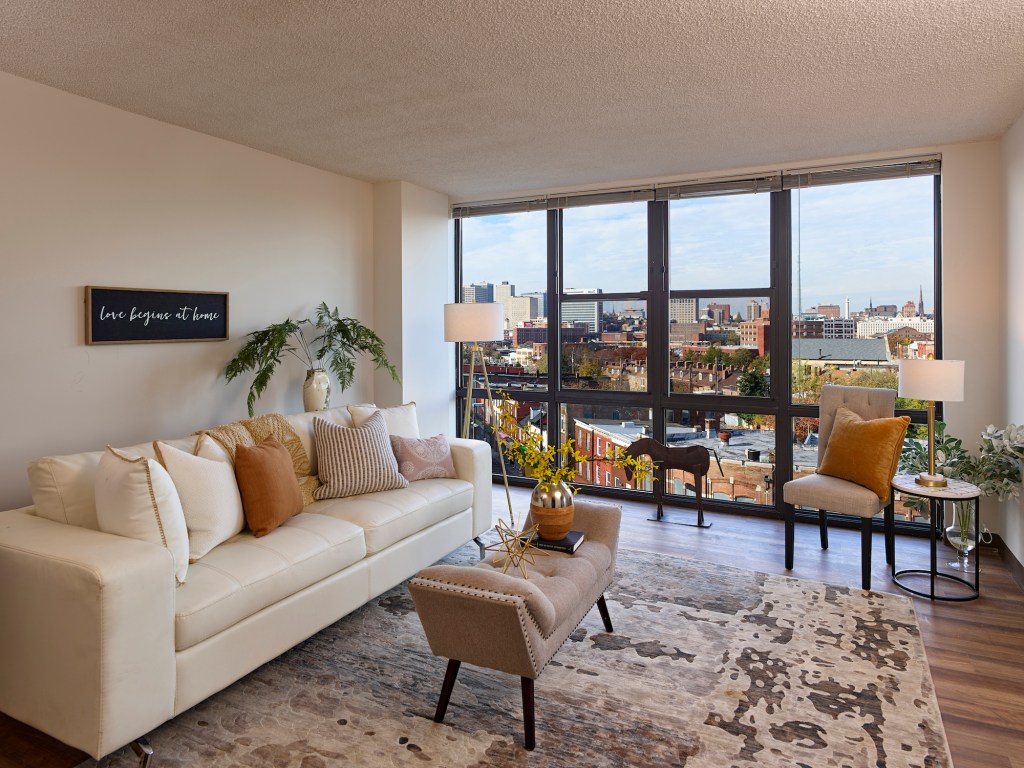
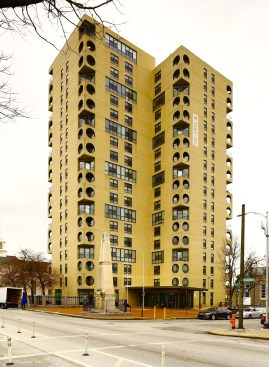
While redevelopment was springing up in the neighborhood around Monument East in Baltimore, the public housing property serving seniors and non-elderly disabled residents had reached obsolescence. Owned by the Housing Authority of Baltimore City (HABC), the building had experienced a significant amount of underinvestment and deferred maintenance.
Thomas Holdsworth
“For the longest time, the structure stood there forgotten, and the residents felt forgotten,” says Aspasia Xypolia, senior project manager at The Community Builders (TCB).
The nonprofit partnered with the HABC to transform the 170-unit building through the Department of Housing and Urban Development’s Rental Assistance Demonstration (RAD) program.
The tenant-in-place renovations included the replacement of kitchens and baths in units, energy-efficient upgrades, and new windows. Heating and cooling systems were modernized, outdoor seating areas and a barbecue were added, and common area amenities were redesigned to repurpose underutilized spaces and prioritize resident programming. Artwork and murals in the building pay homage to the history and culture of the area, requested by the residents.
Health and wellness are also priorities at Monument East, where prior to the renovation emergency vehicles frequented the building on a daily basis. A full-time resident service coordinator connects residents with resources, and a partnership with Medicine for Greater Good provides speakers on a range of health care topics and educations residents to be community health leaders.
Since the redevelopment was completed in February, residents call the building “the heart of East Baltimore.”
“We redeveloped a structure to address residents’ needs,” says Melanie Stern, development project associate. “Now walking through the building, you can see the residents’ pride in the community and their space.”
The redevelopment was Baltimore’s final RAD conversion of public housing, resulting in all 170 units supported by housing assistance payment contracts. The $47.2 million development also utilized 4% low-income housing tax credits and tax-exempt bonds.
PROJECT DETAILS
Developers: The Community Builders and Housing Authority of Baltimore City
Architect: Quinn Evans Architects
General Contractor: Harkins Builders
Major Funders: Housing Authority of Baltimore City; Department of Housing and Urban Development; Maryland Department of Housing & Community Development; city of Baltimore; AGM Financial Services; Bellwether Enterprise; Stratford Capital Group; M&T Bank; Bank of America; Reinvestment Fund